Showing posts with label U.S.. Show all posts

Gloria Steinem: Young women back Bernie Sanders because 'the boys are with Bernie

Sanders

Opinion

During an interview on last night's Bill Maher show, the noted feminist Gloria Steinem suggestedthat young women support Bernie Sanders's presidential campaign because they want attention from men.
Steinem's comments came in response to a question about the base of support for Sanders and Hillary Clinton, respectively.

"When you’re young, you’re thinking, 'Where are the boys?' The boys are with Bernie."
To suggest, as Steinem seemed to do, that young women choose their candidate to attract men is profoundly sexist and condescending. It trivializes the voting preferences of a powerful group of voters: young voters — and particularly young women — while at the same time ignoring gay women.
SEE ALSO: The bros who love Bernie Sanders have become a sexist mob
Steinem's observation also ignores the legitimate gains that Sanders has made among young people. We saw that clearly in Iowa where Sanders defeated Clinton among voters ages 17 to 29 by 70%. That's almost double the margin by which then-Senator Barack Obama won that age group in Iowa in 2008.
Here's a radical idea: Perhaps the women who turned out for Sanders in Iowa aren't boy-crazy. Perhaps they are voters who decided, after hearing the candidates make their arguments, that Sanders is the best candidate to lead the country when Obama leaves office.
Perhaps instead of writing off these voters as lovesick young girls who haplessly follow men to the ballot box, Steinem and others should talk to these young women to try to better understand what makes them Feel The Bern.
The condescension aside, this is also a pretty shocking reversal for Steinem, who, as The New Republic's Elizabeth Bruenig pointed out, once deemed Sanders an "honorary woman" during his 1996 campaign against a Republican woman.
Steinem is a Clinton supporter and wrote rather movingly this year about some of the ugliness that has been hurled Clinton's way by political opponents, dating back to former President Bill Clinton's time at the White House. There's undoubtably a lot of that during this cycle too. I've seen it on the road, on Reddit and on Twitter.
But two wrongs don't make a right. And on this point, Steinem is just dead wrong.
As a relatively young woman (I cast my first vote for President in 2008) and particularly as a black young woman in America, I value my vote and the fight by generations of organizers it took to secure it. It's a responsibility I and many of my friends take incredibly seriously and for anyone to suggest otherwise is frankly insulting.
Sorry, but when I decide who to vote for on Election Day, it will be the person I think can best represent the country, not the candidate that will most impress my boyfriend.

Windows smashed as second night of Berkeley protests turn violent

B4uaumaciaa2nft

A second night of protests against police killings in Missouri and New York turned violent again in Berkeley as some demonstrators threw rocks and bottles at officers, assaulted each other and shut down a freeway, police said.
SEE ALSO: Fifth day of protests against police brutality spread across the U.S.
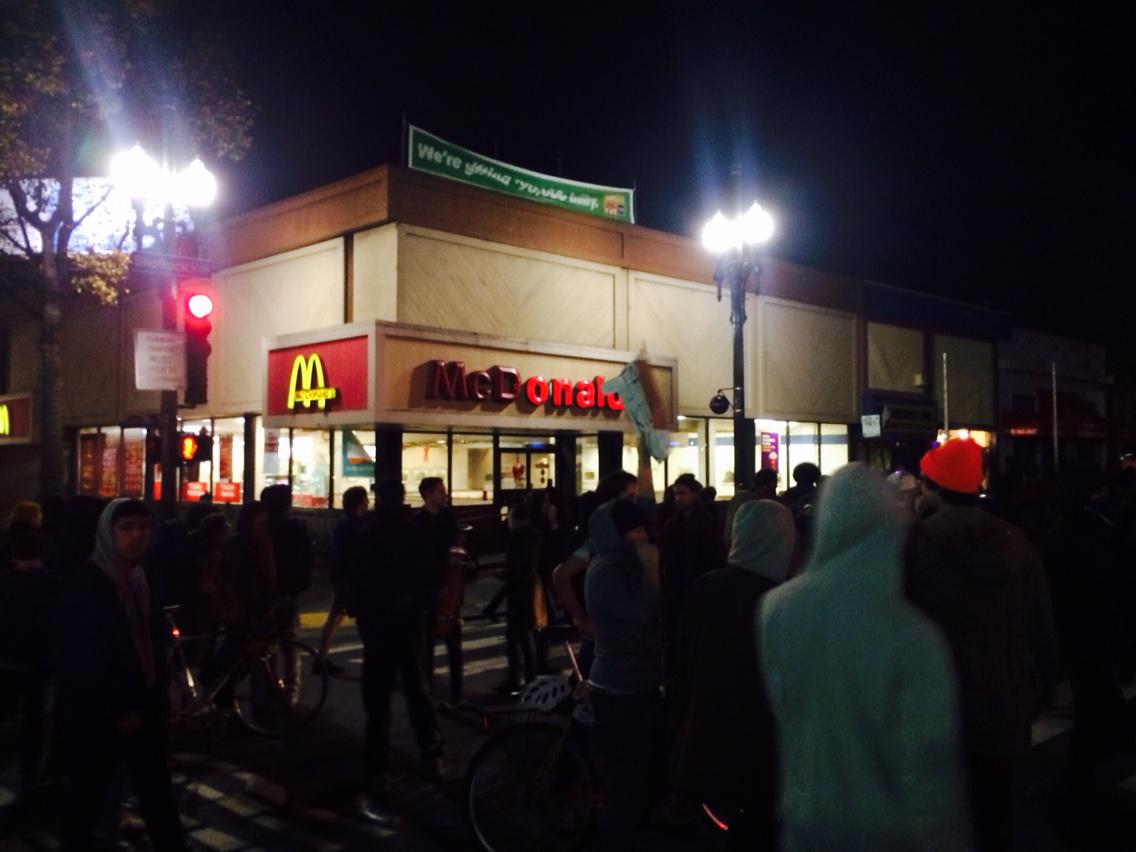
Sunday's protest began peacefully on the University of California, Berkeley campus. But as protesters marched through downtown Berkeley toward the neighboring city of Oakland, the unrest resumed as someone smashed the window of a Radio Shack. When a protester tried to stop the growing vandalism, he was hit with a hammer, Officer Jennifer Coats said.

View image on TwitterView image on TwitterView image on Twitter

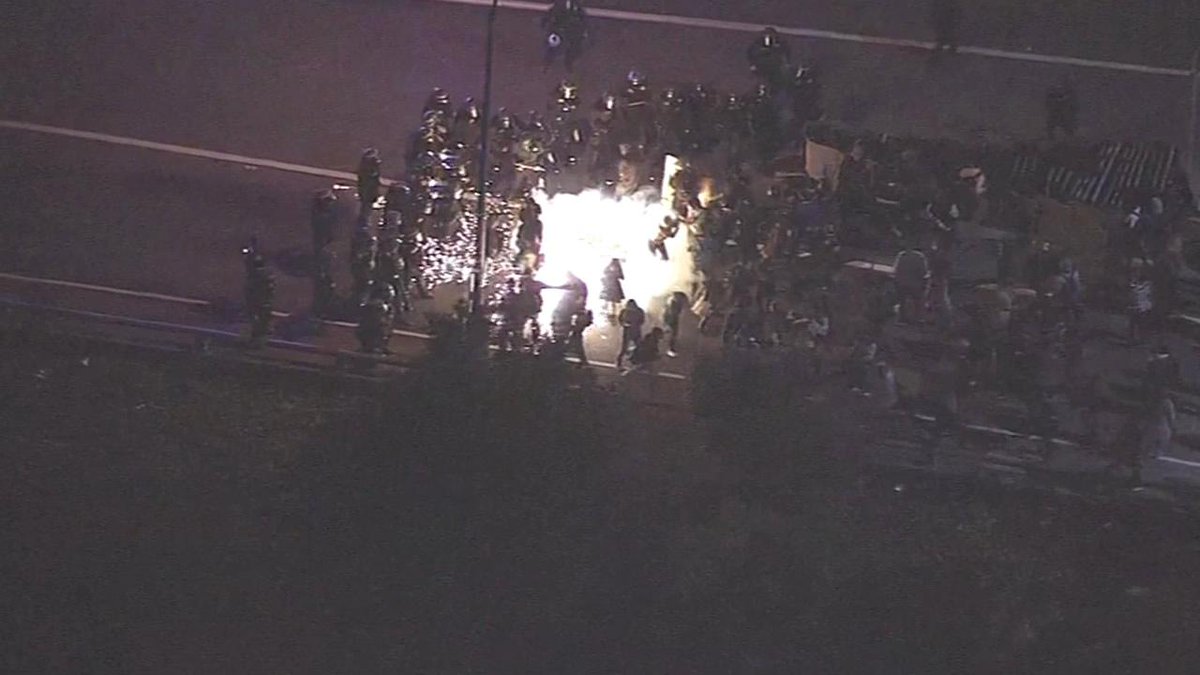
Some of the protesters made their way to a freeway in Oakland and blocked traffic. The California Highway Patrol said some tried to light a patrol vehicle on fire and threw rocks and bottles. Police also said explosives were thrown at officers, but there was no information immediately available on how potent they were. Highway patrol officers responded with tear gas.
View image on Twitter

The highway patrol said it was making arrests but no figures were available.
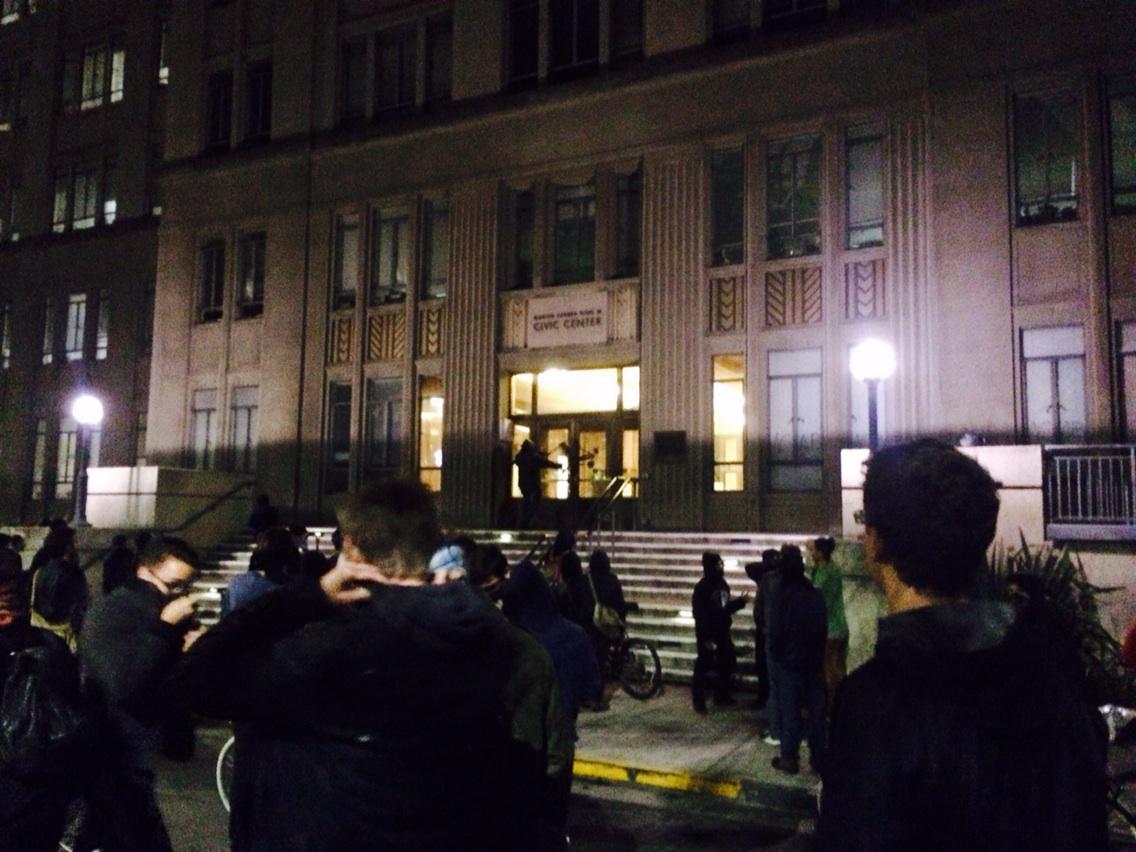
Late Sunday night, police said protesters returned to Berkeley streets, throwing trash cans, scattering garbage and sparking small blazes. Police said several businesses were damaged and looted, and they were checking reports of vandalism at City Hall.
View image on TwitterView image on Twitter
The demonstrations were the latest of several in the Bay Area — including in Oakland where activism is strong — in recent days to protest grand jury decisions in Missouri and New York not to indict while police officers in the deaths of two black men.
On Saturday night, three officers and a technician were hurt and six people were arrested when a similar protest turned unruly. The most serious injury was a dislocated shoulder, Berkeley police said.
Seven people were arrested in Seattle Saturday night after protesters threw rocks at police and attempted to block a highway. Politicians on both sides of the aisle have been calling for calm while activists push for police reforms. NAACP president Cornell William Brooks, appearing on CBS' "Face the Nation," called for outfitting police with body-worn cameras and changing law enforcement policy.
"They need to be listened to and they need to be responded to," Kasich said. "In our country today, there's too much division, too much polarization — black, white; rich, poor; Democrat, Republican. America does best when we're united."
View image on Twitter
The unrest in Berkeley follows violent disruptions of demonstrations in San Francisco and Oakland in recent days. Five San Francisco police officers sought medical treatment after sustaining injuries during a protest in downtown San Francisco on Black Friday.
On Saturday night, protesters broke away from a peaceful demonstration and began throwing rocks, bottles and pipes at officers.
Scores of law officers from several surrounding agencies joined the Berkeley Police Department in trying to quell unrest that went on for hours.
View image on Twitter
The San Francisco Chronicle reported that at one point, the marchers were face to face with a line of about 100 police in riot gear who turned the crowd back.
The newspaper said that it wasn't just protesters who were hit by tear gas.
Several concerts had let out from downtown sites and concertgoers waiting to pay in a nearby garage were enveloped in a cloud of stinging gas, sending them running into elevators.
KCBS reported that police closed two Bay Area Rapid Transit commuter train stations along the protest route.
Protesters had planned to march from the University of California, Berkeley, campus to Oakland's Civic Center.

Windows smashed as second night of Berkeley protests turn violent

B4uaumaciaa2nft

A second night of protests against police killings in Missouri and New York turned violent again in Berkeley as some demonstrators threw rocks and bottles at officers, assaulted each other and shut down a freeway, police said.
SEE ALSO: Fifth day of protests against police brutality spread across the U.S.
Sunday's protest began peacefully on the University of California, Berkeley campus. But as protesters marched through downtown Berkeley toward the neighboring city of Oakland, the unrest resumed as someone smashed the window of a Radio Shack. When a protester tried to stop the growing vandalism, he was hit with a hammer, Officer Jennifer Coats said.

View image on TwitterView image on TwitterView image on Twitter

Some of the protesters made their way to a freeway in Oakland and blocked traffic. The California Highway Patrol said some tried to light a patrol vehicle on fire and threw rocks and bottles. Police also said explosives were thrown at officers, but there was no information immediately available on how potent they were. Highway patrol officers responded with tear gas.
View image on Twitter

The highway patrol said it was making arrests but no figures were available.
Late Sunday night, police said protesters returned to Berkeley streets, throwing trash cans, scattering garbage and sparking small blazes. Police said several businesses were damaged and looted, and they were checking reports of vandalism at City Hall.
View image on TwitterView image on Twitter
The demonstrations were the latest of several in the Bay Area — including in Oakland where activism is strong — in recent days to protest grand jury decisions in Missouri and New York not to indict while police officers in the deaths of two black men.
On Saturday night, three officers and a technician were hurt and six people were arrested when a similar protest turned unruly. The most serious injury was a dislocated shoulder, Berkeley police said.
Seven people were arrested in Seattle Saturday night after protesters threw rocks at police and attempted to block a highway. Politicians on both sides of the aisle have been calling for calm while activists push for police reforms. NAACP president Cornell William Brooks, appearing on CBS' "Face the Nation," called for outfitting police with body-worn cameras and changing law enforcement policy.
"They need to be listened to and they need to be responded to," Kasich said. "In our country today, there's too much division, too much polarization — black, white; rich, poor; Democrat, Republican. America does best when we're united."
View image on Twitter
The unrest in Berkeley follows violent disruptions of demonstrations in San Francisco and Oakland in recent days. Five San Francisco police officers sought medical treatment after sustaining injuries during a protest in downtown San Francisco on Black Friday.
On Saturday night, protesters broke away from a peaceful demonstration and began throwing rocks, bottles and pipes at officers.
Scores of law officers from several surrounding agencies joined the Berkeley Police Department in trying to quell unrest that went on for hours.
View image on Twitter
The San Francisco Chronicle reported that at one point, the marchers were face to face with a line of about 100 police in riot gear who turned the crowd back.
The newspaper said that it wasn't just protesters who were hit by tear gas.
Several concerts had let out from downtown sites and concertgoers waiting to pay in a nearby garage were enveloped in a cloud of stinging gas, sending them running into elevators.
KCBS reported that police closed two Bay Area Rapid Transit commuter train stations along the protest route.
Protesters had planned to march from the University of California, Berkeley, campus to Oakland's Civic Center.

U.S. sends 6 Guantanamo Bay prisoners to Uruguay to be resettled as refugees

Guantanamo-bay-uruguay

MIAMI — Six prisoners held for 12 years at Guantanamo Bay have been sent to Uruguay to be resettled as refugees, the U.S. government announced Sunday — a deal that had been delayed for months by security concerns at the Pentagon and political considerations in the South American country.
The six men — four Syrians, a Tunisian and a Palestinian — are the first prisoners transferred to South America from the U.S. base in Cuba, part of a flurry of recent releases amid a renewed push by U.S. President Barack Obama to close the prison.
SEE ALSO: U.S. sends 5 Guantanamo prisoners to Georgia, Slovakia
All were detained as suspected militants with ties to al-Qaeda in 2002, but were never charged. They had been cleared for release since 2009, but could not be sent home, and the U.S. struggled to find countries willing to take them.
Uruguayan President Jose Mujica agreed to accept the men as a humanitarian gesture, and said they would be given help getting established in a country with a tiny Muslim population of perhaps 300 people.
"We are very grateful to Uruguay for this important humanitarian action, and to President Mujica for his strong leadership in providing a home for individuals who cannot return to their own countries," U.S. State Department envoy Clifford Sloan said.
Among those transferred was Abu Wa'el Dhiab, a 43-year-old Syrian on a long-term hunger strike protesting his confinement, who was at the center of a legal battle in U.S. courts over the military's use of force-feeding.
The Pentagon identified the other Syrians sent to Uruguay on Saturday as Ali Husain Shaaban, 32; Ahmed Adnan Ajuri, 37; and Abdelahdi Faraj, 39. Also released were Palestinian prisoner Mohammed Abdullah Taha Mattan, 35, and 49-year-old Adel bin Muhammad El Ouerghi of Tunisia.
Uruguayan officials declined comment Sunday on the transfers. Adriana Ramos, a receptionist at a military hospital in Montevideo, the capital, said the six men were being examined there, but declined to provide any details.
Cori Crider, a lawyer for Dhiab from the human rights group Reprieve, praised Mujica, a former political prisoner himself, for accepting the men.
"Despite years of suffering, Mr. Dhiab is focused on building a positive future for himself in Uruguay," said Crider, who traveled to Montevideo to meet with him, and was concerned about his health after his prolonged hunger strike. "He looks forward to being reunited with his family and beginning his life again."
Ramzi Kassem, a lawyer for Faraj, said he was "deeply grateful" to Uruguay for accepting the prisoner.
"By welcoming our client and the others as refugees and free men, not as prisoners, Uruguay has shown that it truly possesses the courage of its convictions," Kassem, a law professor at the City University of New York, said in an interview from Panama.
"We hope that other countries in Latin America and throughout the world will soon follow Uruguay's example, and help put an end to the U.S. government's shameful practice of indefinite imprisonment without charge or fair process," he added.
The U.S. has now transferred 19 prisoners out of Guantanamo this year — all but one of them within the last 30 days. Saturday's move brings the total number of prisoners still at Guantanamo to 136 — the lowest number since shortly after the prison opened in January 2002. Officials say several more releases are expected by the end of the year.
Obama administration officials had been frustrated that the transfer took so long, blaming outgoing Defense Secretary Chuck Hagel for not approving the move sooner. They said after Mujica had agreed to take the men in January, the deal sat for months on Hagel's desk, awaiting his signature as required by law. The Pentagon didn't send notification of the transfer to U.S. Congress until July.
By then, the transfer had become an issue in Uruguay's political election, and officials there decided to postpone it until after the vote. Tabare Vazquez, a member of Mujica's ruling coalition and a former president, won a runoff election on Nov. 30.
Upon taking office, Obama had pledged to close the prison, but was blocked by Congress, which banned sending prisoners to the U.S. for any reason, including trial, and placed restrictions on sending them abroad.
The slow pace of releases has created a tense atmosphere inside the prison. A hunger strike that began in February 2013 totaled about 100 prisoners at its peak, including Dhiab and Faraj.
The U.S. now holds 67 men at Guantanamo who have been cleared for release or transfer, but like the six sent to Uruguay, can't go home because they might face persecution, a lack of security or other reasons.
Prisoners from Guantanamo have been sent around the world, but this weekend's transfer was the largest group sent to the Western Hemisphere. Four Guantanamo prisoners were sent to Bermuda in 2009, and two were sent to El Salvador in 2012, but have since left.

Former Apple exec sentenced to one year in prison for selling company secrets

Appbrs9087

A former Apple executive who sold some of the iPhone maker's secrets to suppliers will serve a year in prison and repay $4.5 million for his crimes.
Paul S. Devine was sentenced in San Jose federal court earlier this week, more than three years after he pleaded guilty to wire fraud, conspiracy and money laundering.
SEE ALSO: Report: Russia Hacked 'Hundreds' of Companies Worldwide
The U.S. Attorney's office announced Devine's penalty Friday, but declined to explain the reason for the lengthy delay in his sentencing.
Devine faced up to 20 years in prison.
The scheme funneled millions in kickbacks to Devine for passing along confidential information to Apple Inc. suppliers and manufacturers who used the secrets to negotiate more favorable deals.
Devine was a global supply manager at Apple from 2005 until his 2010 arrest.

Sobering daylight in Ferguson exposes a city in shambles

Ferguson3

Daylight shed a sobering light on Ferguson, Missouri, and the surrounding communities on Tuesday after a night of violent protests rocked the city.
Tensions quickly rose following the announcement that Ferguson police officer Darren Wilson would not be indicted for the shooting death of unarmed teenager Michael Brown on Aug. 9. Protesters swiftly took to the streets demanding justice for Brown.
By the end of the night, businesses had been burned, cars torched, stores looted and shots fired. The protests escalated far beyond any of the uprising in Ferguson in August.
Overnight, 61 people were arrested in Ferguson, according to St. Louis County Police spokesman Brian Schellman. Less than 10 miles away, in St. Louis, there were 21 arrests, according to St. Louis Mayor Francis Slay.
Speaking during a press conference on South Grand Avenue on Tuesday morning, Slay appealed for peace in the community amid piles of broken glass; 21 windows were broken in the area overnight, Slay added.
"I first and foremost condemn the terrible violence that occurred in Ferguson," said Slay. "
 A storage site was still smoldering on Tuesday morning after being set alight on Monday night.It's unacceptable, it's wrong. The vast majority of people living in our region condemn it as well."
View image on Twitter
One reporter surveying the scene likened the streets of Ferguson to a city after a natural disaster.
View image on Twitter
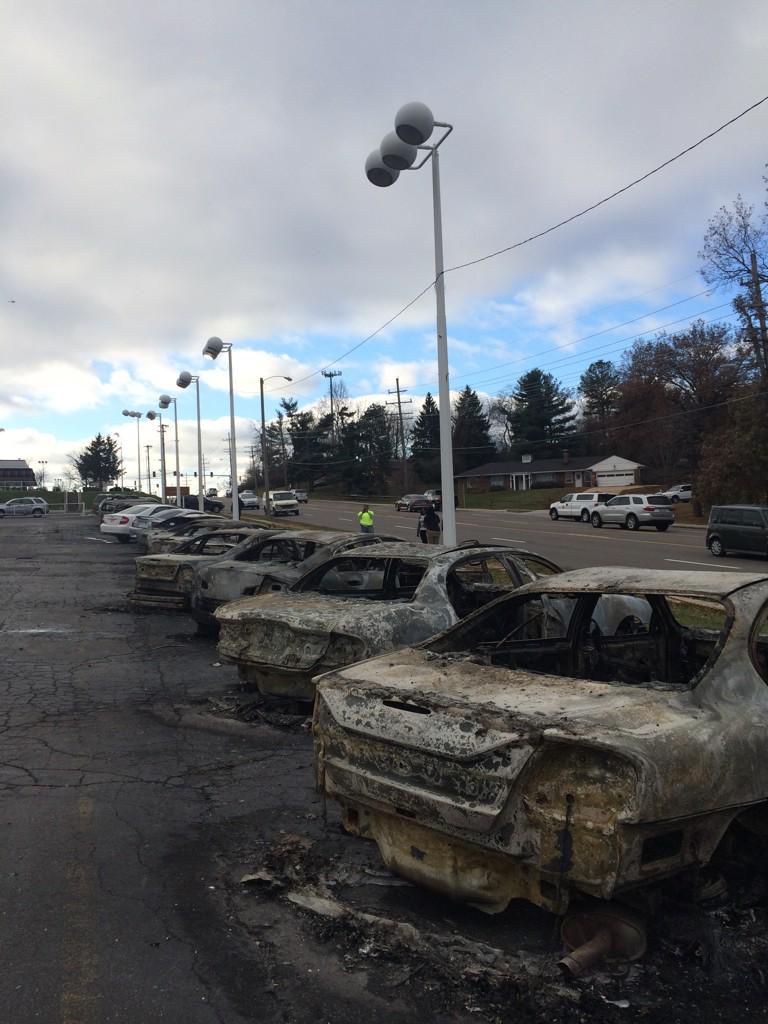
Burned out cars lined the streets near Ferguson City Walk.

It's unacceptable, it's wrong. The vast majority of people living in our region condemn it as well."A storage site was still smoldering on Tuesday morning after being set alight on Monday night.


View image on Twitter
Local businesses remained boarded up while some community members took to the streets to begin cleanup efforts.
View image on Twitter


Mayor Slay emphasized that violent protesters made up just a small portion of the larger group of demonstrators.

"This is a very good community of a lot of people who care deeply about our city who are investing in their community. they are working hard to bring back this area of the city," Slay said.

 "They don't deserve it. The people of our community do not deserve this kind of violence."


View image on Twitter


Drone Beat: Flying in Gaza, at a Congressman's Wedding and More

Israeli-drone

The U.S. government uses them to bomb alleged terrorists in far-away places. Tech companies like Amazon, Google and Facebook are all toying with the idea of using them, and now they're a photographer's secret weapon. Drones are a big part of our lives, whether we see them or not. Drone Beat collects the best and most important stories every week.


Judge delivers another blow to the FAA

For the second time in just over four months, a judge has ruled against the Federal Aviation Administration (FAA) in a case involving drones.
On Friday, an appeals court judge said that EquuSearch, a Texas-based company that uses UAVs for search and rescue operations can legally fly its drones, and that the cease and desist email that the FAA sent the group earlier this year didn't have any legal effects, as reported byMotherboard.
The ruling was a win for EquuSearch, which will resume its drone flights right away. However, the ruling doesn't address the larger issues regarding drone regulation, which at this point aremurky, but it's a huge loss for the FAA, which has to face yet another court ruling saying that the agency is on shaky ground when it comes to preventing pilots from flying drones.
"The court's decision in favor of the FAA regarding the Texas EquuSearch matter has no bearing on the FAA's authority to regulate" drones, the agency said in a statement. "The FAA remains legally responsible for the safety of the national airspace system. This authority is designed to protect users of the airspace as well as people and property on the ground."

Drone wars between Israel and Hamas

Earlier this week, Israel claimed to have shot down a drone controlled by Hamas. The militants later claimed to have developed three types of drones, including two capable of carrying out attacks.
The group even posted a video on YouTube purportedly showing one of the drones, seemingly armed with missiles — although experts consulted by Mashable were skeptical of the drone's real capabilities.


Congressman hires drone to shoot wedding, gets investigated

Rep. Sean Patrick Maloney (D-N.Y.) paid an aerial photography company to shoot his wedding with a drone last month, as revealed this week.
As we've noted repeatedly, the FAA says that the commercial use of drones — including hiring photography companies to take pictures using them — is prohibited. Perhaps Maloney was unaware of the regulations? Probably not, since he actually sits on a congressional subcommittee that oversees the FAA itself.
In any case, his use of flying bots to film his wedding is now under FAA investigation.
As Quartz noted, Maloney is hardly the only one who is doing this. Several photography companies are offering their services for weddings

Students Sue Google for Monitoring Their Emails

Google.jpg

In a challenge to one of Google's more controversial practices, a group of students in California are suing Google, claiming that the company's monitoring of Gmail violates federal and state privacy laws.
The U.S. District Court for the Northern District of California is currently hearing the complaint from nine students whose emails were subject to Google surveillance because Gmail is a component of Apps for Education. Apps for Education is a suite of free, web-based education tools that has some 30 million users worldwide, most of whom are students under 18 exposed to the software via their schools.
A Google rep told Education Week that the company scans and indexes emails from all Apps for Education users. The company uses the data for potential advertising, among other purposes.
Education Week speculates that the case could have "major implications" for how the Family Educational Rights and Privacy Act [FERPA] is interpreted. FERPA, which was issued in 1974, ensures the privacy of records of students under the age of 18. The Department of Education'srecent guidance on the issue also appears to indirectly state that Google's Gmail practices run afoul of FERPA.
The students are seeking class-action certification for the case.  
If successful, that could lead to a payment to millions of Gmail users. However, in a victory for Google, U.S. District Judge Lucy Koh in San Jose, Calif., on Tuesday declined to combine other related suits against Google's Gmail on similar grounds into one class-action suit.Google's surveillance of Gmail for advertising purposes has raised hackles among privacy advocates. In particular, the ElectronicPrivacy Information Center (EPIC) points out that even if Gmail users agree to Google's terms, that doesn't mean that non-subscribers who email with them do. "Non-subscribers have not consented and indeed may not even be aware that their communications are being analyzed or that a profile may be compiled of him or her," states anFAQ on EPIC on the subject. EPIC also takes issue with Google's ability to compile a detailed profile of a Gmail user by linking their Gmail data with cookies used by Google's search engine. Google has said that it doesn't cross-reference such data.

Microsoft has also criticized Google's Gmail practices in its Scroogled campaign, contrasting Google's data mining with Microsoft's Outlook, which doesn't use email data to serve users ads.

From Bethlehem to D.C.: Christmas Around the World

United-states-2

On Christmas Eve, two American astronauts spent the day in space, working to fix the cooling system on the International Space Station.
Down here on Earth, though, the celebrations are mostly confined to land and sea. From soldiers sharing a special meal in Afghanistan to Santa waterskiing in Maryland, people and cultures around the world observe Christmas Day with their own sets of traditions. Some of these traditions are centuries old, like gathering in the little town of Bethlehem; others were brought on by circumstance this year, like families in Tacloban, Philippines, finding Christmas joy amid the post-Typhoon Haiyan destruction.
Our collection of Christmases, below, traverses the globe in 28 photos.