Showing posts with label Politics. Show all posts

Gloria Steinem: Young women back Bernie Sanders because 'the boys are with Bernie

Sanders

Opinion

During an interview on last night's Bill Maher show, the noted feminist Gloria Steinem suggestedthat young women support Bernie Sanders's presidential campaign because they want attention from men.
Steinem's comments came in response to a question about the base of support for Sanders and Hillary Clinton, respectively.

"When you’re young, you’re thinking, 'Where are the boys?' The boys are with Bernie."
To suggest, as Steinem seemed to do, that young women choose their candidate to attract men is profoundly sexist and condescending. It trivializes the voting preferences of a powerful group of voters: young voters — and particularly young women — while at the same time ignoring gay women.
SEE ALSO: The bros who love Bernie Sanders have become a sexist mob
Steinem's observation also ignores the legitimate gains that Sanders has made among young people. We saw that clearly in Iowa where Sanders defeated Clinton among voters ages 17 to 29 by 70%. That's almost double the margin by which then-Senator Barack Obama won that age group in Iowa in 2008.
Here's a radical idea: Perhaps the women who turned out for Sanders in Iowa aren't boy-crazy. Perhaps they are voters who decided, after hearing the candidates make their arguments, that Sanders is the best candidate to lead the country when Obama leaves office.
Perhaps instead of writing off these voters as lovesick young girls who haplessly follow men to the ballot box, Steinem and others should talk to these young women to try to better understand what makes them Feel The Bern.
The condescension aside, this is also a pretty shocking reversal for Steinem, who, as The New Republic's Elizabeth Bruenig pointed out, once deemed Sanders an "honorary woman" during his 1996 campaign against a Republican woman.
Steinem is a Clinton supporter and wrote rather movingly this year about some of the ugliness that has been hurled Clinton's way by political opponents, dating back to former President Bill Clinton's time at the White House. There's undoubtably a lot of that during this cycle too. I've seen it on the road, on Reddit and on Twitter.
But two wrongs don't make a right. And on this point, Steinem is just dead wrong.
As a relatively young woman (I cast my first vote for President in 2008) and particularly as a black young woman in America, I value my vote and the fight by generations of organizers it took to secure it. It's a responsibility I and many of my friends take incredibly seriously and for anyone to suggest otherwise is frankly insulting.
Sorry, but when I decide who to vote for on Election Day, it will be the person I think can best represent the country, not the candidate that will most impress my boyfriend.

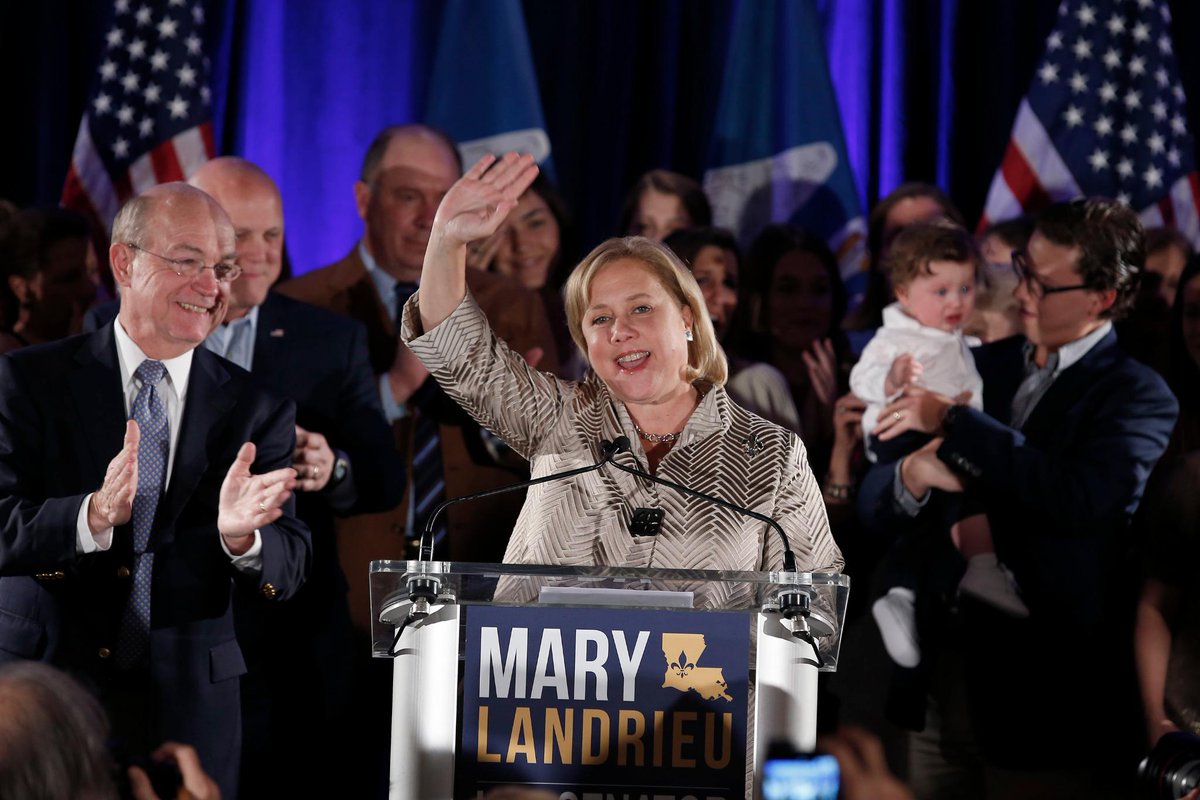
In a blow to Democrats, Louisiana Sen. Mary Landrieu defeated

Senate-louisiana-election

BATON ROUGE, La. — Republican Rep. Bill Cassidy defeated Democratic Sen. Mary Landrieu on Saturday, denying her a fourth term and extending the GOP's domination of the 2014 midterm elections that put Republicans in charge of Capitol Hill for the final two years of President Barack Obama's tenure.
With Cassidy's victory, Republicans will hold 54 seats when the Senate convenes in January, nine more than they have now. Republican victories in two Louisiana House districts Saturday — including the seat Cassidy now holds — ensure at least 246 seats, compared to 188 for Democrats, the largest GOP advantage since the Truman administration after World War II. An Arizona recount leaves one race still outstanding.
SEE ALSO: Senate rejects Keystone XL pipeline
With nearly all the votes counted, unofficial returns showed Cassidy with a commanding victory.
View image on Twitter
Landrieu had narrowly led a Nov. 4 primary ballot that included eight candidates from all parties. But at 42 percent, she fell well below her marks in previous races and endured a one-month runoff campaign that Republicans dominated via the air waves while national Democrats financially abandoned her effort.
Landrieu's defeat is a blow for one of Louisiana's most famous political families, leaving her brother, New Orleans Mayor Mitch Landrieu, to carry the banner.
The GOP sweep also denied former Gov. Edwin Edwards a political comeback; the colorful 87-year-old politician, who had served four terms as governor in the past, sought a return to public office after eight years in federal prison on corruption charges.
In the South, Democrats will be left without a single governor or U.S. senator across nine states stretching from the Carolinas to Texas. The House delegations from the same region are divided almost entirely by race, with white Republicans representing majority-white districts, while majority non-white districts are represented by black or Hispanic Democrats.
Cassidy, who spent most of his campaign linking Landrieu to Obama, called his win "the exclamation point" on the message that voters sent nationally on Nov. 4.
"This victory happened because people in Louisiana voted for a government that serves us, that does not tell us what to do," Cassidy said in a brief victory speech in Baton Rouge.
He did not mention Obama or offer any specifics about his agenda in the Senate, but said he believes voters have demanded "a conservative direction" on health care, budgets and energy policy. Cassidy did not take questions after his speech.
Speaking a half hour before in New Orleans, Landrieu struck an upbeat chord. "We may not have won tonight, but we have certainly won some extraordinary victories," she told supporters, citing her role in directing additional oil and gas royalties to Louisiana and securing federal aid after multiple hurricanes and the 2010 Gulf Oil Spill.
"It's been a fight worth waging," she said. "Louisiana will always be worth fighting for."
She also said she was "proud" of her efforts to expand health care access, though she didn't specifically mention the Affordable Care Act.
The Louisiana race mirrored contests in other states Obama lost in 2012, with Landrieu, 59, joining Alaska Sen. Mark Begich, North Carolina Sen. Kay Hagan and Arkansas Sen. Mark Pryor in defeat. Democrats ceded seats in Montana, South Dakota and West Virginia after incumbents opted not to run again.
But in a state where 73 percent of white voters on Nov. 4 told pollsters they "strongly disapproved" of the president, that was enough to prevent Landrieu from finding her footing. Cassidy also enjoyed a prodigious advertising advantage in the runoff: Of every dollar spent by outside groups during the one-month runoff, 97 cents benefited the congressman.

Like victorious Republicans in those races, Cassidy, 57, made his bid against Landrieu more about Obama than about his own vision for the job. An Illinois native, Cassidy made few public appearances during the runoff, seeking to avoid missteps that could change the race.

Landrieu tried several messages over the course of her losing effort.
Most recently, she had hammered Cassidy as unfit for the job and more interested in partisanship than helping Louisiana. She directed her most pointed criticism at Cassidy's medical teaching job in Louisiana State University's hospital system.
Calling Cassidy "Dr. Double Dip," Landrieu suggested he collected a $20,000, taxpayer-funded salary for little or no work, describing gaps and discrepancies in Cassidy's LSU timesheets. LSU said it's looking into the timesheet questions.
She argued that the race shouldn't be about Obama, but also targeted advertising on radio stations geared to the black community, where the president remains popular.
Her anchor argument was that her seniority was a boon for Louisiana, particularly her chairmanship of the Senate's energy committee, an important panel for this oil-rich state. But that argument was gutted on Nov. 4 when Republicans won the Senate majority, meaning Landrieu would have lost her post even had she won.

China Wants a Manned Moon Mission, Experts Say

Moon-sr1

China this week became the third nation to land a rover on the Moon, and experts believe the country will follow up with a manned mission to the lunar surface in just a matter of years. The country's rapidly improving program and America's perceived lack of direction could, years from now, lead to a new space race.
The spacecraft Chang'e 3 and its rover, Yutu, are only on the lunar surface to explore. But China's zeal for space is unmatched, and its program is developing fast — to the point that it can be recognized as a space power. Just what that means for the U.S. is up for debate.
"I'm not saying they're militarizing space, or occupying it or [that] they're going to claim the moon ... but there's always that consideration in that relationship between countries," Paul Spudis, a scientist at the Lunar and Planetary Institute, told Mashable.
For Spudis, the issue is not China's presence in the lunar region, but the United States' absence. He's worried a country that doesn't advocate for a free market could some day stifle how other nations and private businesses operate in space.
"I don't think it's anything to panic about," Spudis said. "It's something to think about seriously."
John Logsdon, former director of the Space Policy Institute at George Washington University, told Mashable that if China wants to play with the big powers on Earth, they bhad etter play with them in space, too. That means, at some point, a manned trip to the Moon.
China has launched several military satellites, which have also caused consternation among some U.S. officials. But Logsdon thinks China's program has caused undue alarm. What the Chinese have done is impressive, sure, but they're a long way from their own mission to Mars.
"People have very short attention spans," Logsdon said. "A year and a half ago we landed a remarkable rover on Mars, and it's producing all kinds of discoveries."
Pascal Lee, planetary scientist at the Search for Extraterrestrial Intelligence Institute, toldMashable he wouldn't disagree that America's program is superior. But he feels China's recent success needs to renew American interest in the space program because Beijing's progress has been steady for years, and their missions have so far been almost flawless.
What's more, China seems to have its eyes on tougher missions in the near future. Chang'e 3 is big enough to hold much more than the rover it deposited, meaning the Chinese could have fit a larger, more capable robot in there. With a few more upgrades, they might be able to squeeze in a person or two.
"The truth is these events are really remarkable and they need to get our attention," Lee said. "As soon as we see a Chinese astronaut walking on the Moon, I think it's going to become a national interest of the U.S. to get back to the Moon."

NSA Targeted Unicef and Israeli Prime Minister

National_security_agency_headquarters_fort_meade_maryland

The UK Government Communications Headquarters and the National Security Agency had their sights on a European Union official, German government buildings, several international humanitarian organizations and the Israeli prime minister, according to a joint investigation by The Guardian, Der Spiegel and The New York Times.
Two of the more prominent targets were Unicef, the United Nations' children's charity, and Ehud Olmert, who was Israel's prime minister in 2009. The government institutions had also listed German government buildings in Berlin and outside the country, the European Union's Competition advisor, the head of the Economic Community of West African States, and more as potential marks, according to the article.

These latest revelations were pulled from the documents leaked by former NSA contractor Edward Snowden, who incited a stormy debate surrounding the breadth of U.S. and UK spying. These new allegations come just months after Der Spiegel reported the NSA may have tapped German Chancellor Angela Merkel's phone.
Previous information, which The Guardian also obtained from Snowden, revealed the NSA collects the phone data of American citizens from companies such as AT&T and Verizon.

Who's In, Who's Out at Obama's Meeting of Tech Execs?

President_techPresident Barack Obama will host a meeting with executives from some of the largest technology companies in the world Tuesday, and the list of attendees is notably different from when the president held a similar meeting two years ago.
Obama wants to discuss the borderline-disastrous launch of his online insurance marketplace,Healthcare.gov, which has been plagued with bugs since its Oct. 1 launch. He'll also talk with executives about the breadth of government surveillance, which many of them expressed concern over in a recent open letter to the White House and Congress about limiting surveillance.
Plenty of those companies will attend the meeting, but the firms Obama left off the list from the last meeting, and the ones he added, show which companies the president believes will shape the future of America's tech policy. The White House dropped some venture capital firms, Stanford University, AOL and a few others this time, but added several others, including Comcast, AT&T and Microsoft.
Obama Tech Meeting

Image: Jim Watson/AFP/Getty Images

Below, we've listed which companies attended both meetings, which were left off the first time, and which won't be at the White House today.
Will attend both: Yahoo, Twitter, Netflix, Apple, Google, Facebook
Attended first meeting: Westly Group, Genentech, Stanford University, Oracle, Cisco Systems, Kleiner Perkins Caufield & Byers
Attending only today's meeting: Etsy, Dropbox, Salesforce, Zynga, Sherpa Global, Comcast, LinkedIn, Microsoft, AT&T

Obama Will Meet With Tech Execs to Troubleshoot Healthcare.gov

Obama-tech-execs-healthcarePresident Barack Obama will on Tuesday meet with leaders of Google, Apple, Facebook and more of the world's biggest technology companies to talk about how to improve the White House's much-maligned online health insurance marketplace, Healthcare.gov.
The president will reportedly discuss ways to boost the site's efficiency and capacity, according to Reuters. They will also touch on national security, the impact of intelligence leaks on the American economy and how the tech sector can be used to create jobs and reduce social inequality.
The meeting comes after critics have railed against the bugs and glitches of Healthcare.gov since it launched on Oct. 1. It also follows a recent open letter concerning government surveillance written by many of the companies who will attend the meeting and directed at the president and Congress.
The letter, cosigned by MicrosoftYahoo and more, stated: "The undersigned companies believe that it is time for the world’s governments to address the practices and laws regulating government surveillance of individuals and access to their information."
From the looks of the agenda, it appears the president has agreed to hear privacy concerns in exchange for insight into the shortcomings of the online rollout of his administration's signature law.
Below is a list of the executives who will attend Tuesday's exchange of ideas.
  • Tim Cook, CEO, Apple
  • Dick Costolo, CEO, Twitter
  • Eric Schmidt, Executive Chairman, Google
  • Marissa Mayer, President and CEO, Yahoo
  • Sheryl Sandberg, COO, Facebook
  • Chad Dickerson, CEO, Etsy
  • Reed Hastings, Co-Founder & CEO, Netflix
  • Drew Houston, Founder & CEO, Dropbox
  • Burke Norton, Chief Legal Officer, Salesforce
  • Mark Pincus, Founder, Chief Product Officer & Chairman, Zynga
  • Shervin Pishevar, Co-Founder & Co-CEO, Sherpa Global
  • Brian Roberts, Chairman & CEO, Comcast
  • Erika Rottenberg, Vice President, General Counsel and Secretary, LinkedIn
  • Brad Smith, Executive Vice President and General Counsel, Microsoft
  • Randall Stephenson, Chairman & CEO, AT&T

Energy Department Forewarned About Major Data Hack

TypeBefore computer attackers breached Energy Department personnel systems in July, federal inspectors had been warning officials for years about unencrypted sensitive data and urging them to fix application vulnerabilities — failings that ultimately would lead to the hack of sensitive information on 104,179 individuals, according to a Nextgov review of annual cybersecurity evaluations.
An inspector general special report issued Friday determined that the inability to fix known entry points for hackers made possible a July intrusion into the DOE Employee Data Repository, or DOEInfo, the main Rolodex of records on employees, relatives and contractors. The outsiders stole names, Social Security numbers, banking information, and password questions and answers, among other personal data.
"Critical security vulnerabilities in certain software supporting the [management information system] application had not been patched or otherwise hardened for a number of years," the report stated, referring to the system that connects to DOEInfo. "No efforts had been undertaken to eliminate the unnecessary use of Social Security numbers in the existing DOEInfo database tables even though the requirement to do so was over 5 years old."
Among the potential doorways for hackers cited in an August 2009 IG report is that sensitive information on laptops and handhelds, as well as data sent by email, was not always encrypted. Energy officials also permit unencrypted files to be transmitted to offsite storage facilities.
A similar IG evaluation from October 2011 revealed network weaknesses had spiked 60% between fiscal 2010 and fiscal 2011. The security gaps documented included lax access controls and software defects.
Inspectors examining this summer's assault said they could not identify a single fatal flaw, but found several weaknesses that assisted the hackers, many of which, old IG reports show, were flagged previously.
Ultimately, the attackers crept in by using “exploits commonly available on the Internet to gain unfettered access to the relevant systems and exfiltrate large amounts of data — information that could be used to damage the financial and personal interests of many individuals," Friday's report states.
Exploits are hacking tools that take advantage of vulnerabilities — like those found in the earlier IG reports — to break into systems.
Among the factors that aided and abetted the hackers this year: the systems struck were directly accessible through the Web without adequate safeguards and contained vulnerabilities that weren't patched. In addition, the systems stored Social Security numbers in plain text.
Officials had been "permitting systems to operate even though they were known to have critical and/or high risk security vulnerabilities," Friday's report states. “The department had not taken appropriate action to remediate known vulnerabilities on its systems either through patching, system enhancements or upgrades."
According to the 2011 evaluation, tests at 25 facilities, including headquarters, turned up 32 new vulnerabilities plus an additional 24 left unresolved from the prior year.
One year later, a November 2012 inspector general audit found 29 Web applications, including human resource software, did not undergo “validation” to regularly check that program changes were authorized.
On Friday, Energy officials said work is underway to address the inspector general's latest discoveries. The department is examining all online systems and applications, as well as instituting new protections to restrict unauthorized disclosure. All superfluous personal information and Social Security numbers will be expunged from systems by the end of January 2014, officials said. And encryption tools will be installed to protect remaining sensitive information.

Man Who Joined Anonymous Attack for '1 Minute' Fined $183,000

Man Who Joined Anonymous Attack for '1 Minute' Fined $183,000Anon

A 38-year-old man was sentenced to two years probation and a hefty fine for participating in a distributed denial-of-service attack organized by hacker collective Anonymous against the webpage of Koch Industries in 2011.
The surprising part? He only joined the attack for one minute.
Eric J. Rosol, a Wisconsin resident, was charged with being part of Anonymous’ attack on the Kansas-based company, Kochind.com, on Feb. 28, 2011, using a popular DDoS tool, which was found on his computer.
Rosol, however, says he was part of the attack for one minute. He pleaded guilty to one misdemeanor count of accessing a protected computer, and was sentenced to two years of federal probation and ordered to pay $183,000, the Department of Justice said in a statement acquired by IT World. The monetary amount is equal to what Koch paid for a consulting group to come in post-attack and fix their website. The attack itself only took Koch’s website down for about 15 minutes.
Similar crimes have also carried heavy punishments. Jeremy Hammond, 28, a member of Anonymous, was sentenced last month to 10 years in prison for hacking intelligence contractor Strategic Forecasting, also known as Stratfor.
Activists have claimed that such hacking sentences are disproportionate to the crimes and called for reform of the Computer Fraud and Abuse Act, which was passed in the 1980s and is still used to prosecute online crime today.

9 Essential Twitter Sources for Ukrainian Conflict News

9 Essential Twitter Sources for Ukrainian Conflict NewsUkraineprotests

Events in the Ukrainian capital of Kiev have moved rapidly over the past week or so. Not surprisingly, Twitter and other social channels have often been the most up-to-date sources of information on the unfolding conflict.
In a nutshell, the tension there revolves around President Viktor Yanukovych's abrupt decision to reject a broad free-trade agreement with the European Union, which much of the Ukrainian public seems to favor, and instead focus his economic attention toward Moscow. Many of the protesters are demanding the removal of Yanokovych and the reinstatement of the EU trade pact.

20 Incredible Images of Massive Protests in Ukraine
For useful updates, here are some sources we have been following.

1. Kyiv Post, English-language newspaper in Ukraine

2. Christopher Miller, Kyiv Post editor

3. David Herszenhorn, New York Times correspondent

4. Max Seddon, BuzzFeed correspondent

5. James Marson, Wall Street Journal correspondent

6. Anastasia Vlasova, Kyiv Post photojournalist

7. Maxim Tucker, writing for The Independent

8. Evgeny Feldman, photographer (Russian language)

More of his photos can be found here.

9. Maxim Eristavi, editor in chief, @Golos106fm

In addition, several people have been producing live stream video at various points in the conflict. We've been watching this one today, via USTREAM.

Google, Microsoft Lead Campaign to Limit Government Surveillance

Google, Microsoft Lead Campaign to Limit Government SurveillanceSurveillance

Eight technology giants, including Google and Microsoft, have started a public campaign to limit government surveillance of users, The New York Times reports.
The companies — Google, Microsoft, Apple, Facebook, Twitter, AOL, LinkedIn, and Yahoo — published an open letter in national newspapers and opened a website at reformgovernmentsurveillance.com (which, curiously, doesn't work at the time of this writing).

Google’s Schmidt: NSA Spying on Data Centers Is 'Outrageous'
In the letter, the Reform Government Surveillance group is calling for the U.S. President and Congress to limit surveillance of people, as it "undermines" their freedoms.
"We understand that governments have a duty to protect their citizens. But this summer's revelations highlighted the urgent need to reform government surveillance practices worldwide," the letter said.
“The balance in many countries has tipped too far in favor of the state and away from the rights of the individual — rights that are enshrined in our Constitution. This undermines the freedoms we all cherish.”
The initiative comes after a string of leaks this summer, detailing the NSA's extensive surveillance of users, including spying on data centers of Google, Microsoft, Yahoo and other tech companies.