Showing posts with label US & World. Show all posts

Windows smashed as second night of Berkeley protests turn violent

B4uaumaciaa2nft

A second night of protests against police killings in Missouri and New York turned violent again in Berkeley as some demonstrators threw rocks and bottles at officers, assaulted each other and shut down a freeway, police said.
SEE ALSO: Fifth day of protests against police brutality spread across the U.S.
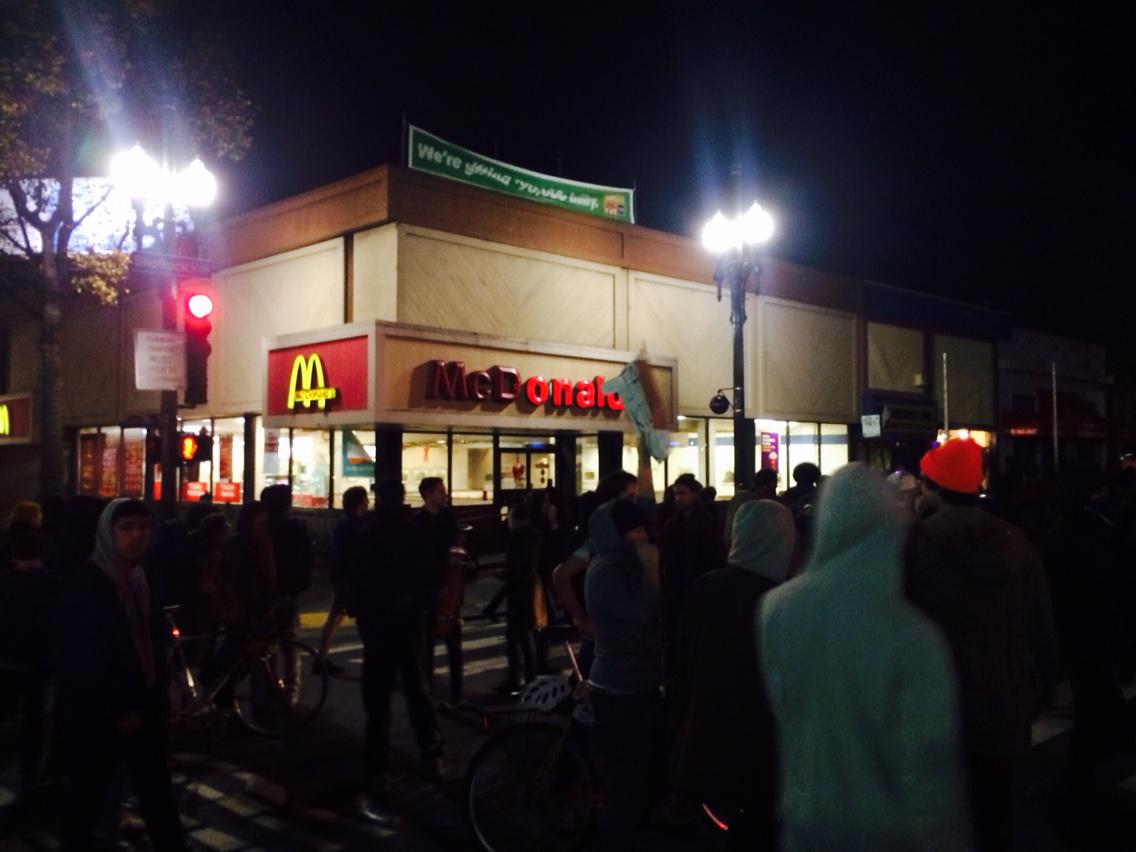
Sunday's protest began peacefully on the University of California, Berkeley campus. But as protesters marched through downtown Berkeley toward the neighboring city of Oakland, the unrest resumed as someone smashed the window of a Radio Shack. When a protester tried to stop the growing vandalism, he was hit with a hammer, Officer Jennifer Coats said.

View image on TwitterView image on TwitterView image on Twitter

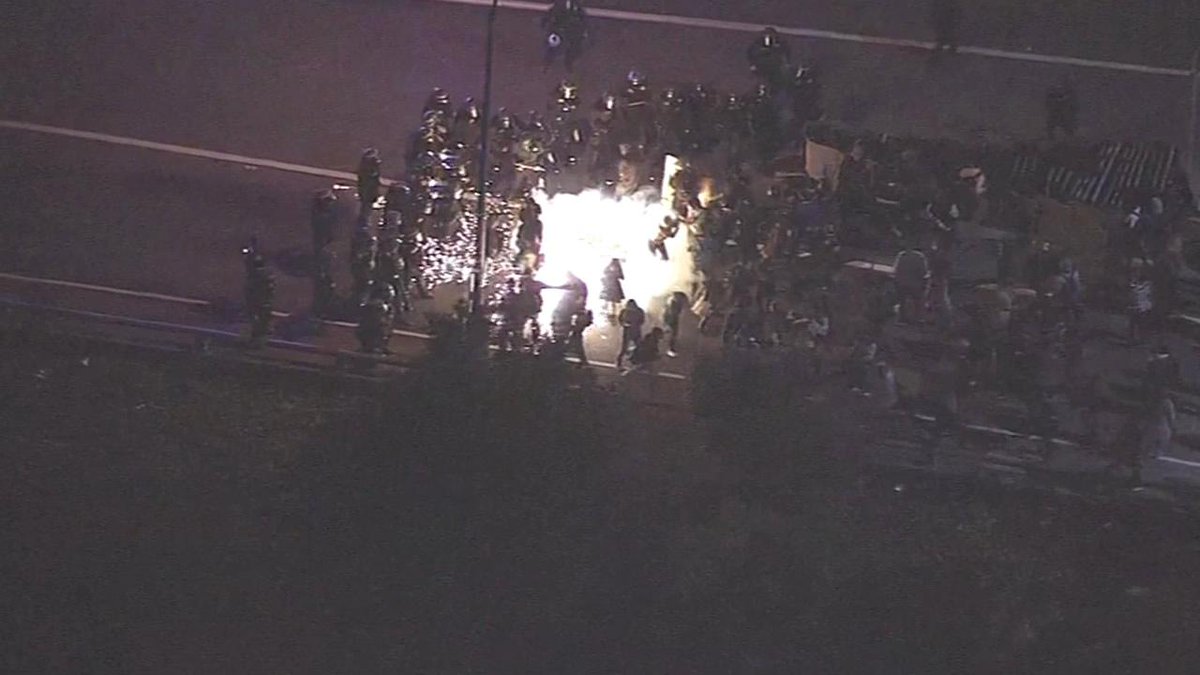
Some of the protesters made their way to a freeway in Oakland and blocked traffic. The California Highway Patrol said some tried to light a patrol vehicle on fire and threw rocks and bottles. Police also said explosives were thrown at officers, but there was no information immediately available on how potent they were. Highway patrol officers responded with tear gas.
View image on Twitter

The highway patrol said it was making arrests but no figures were available.
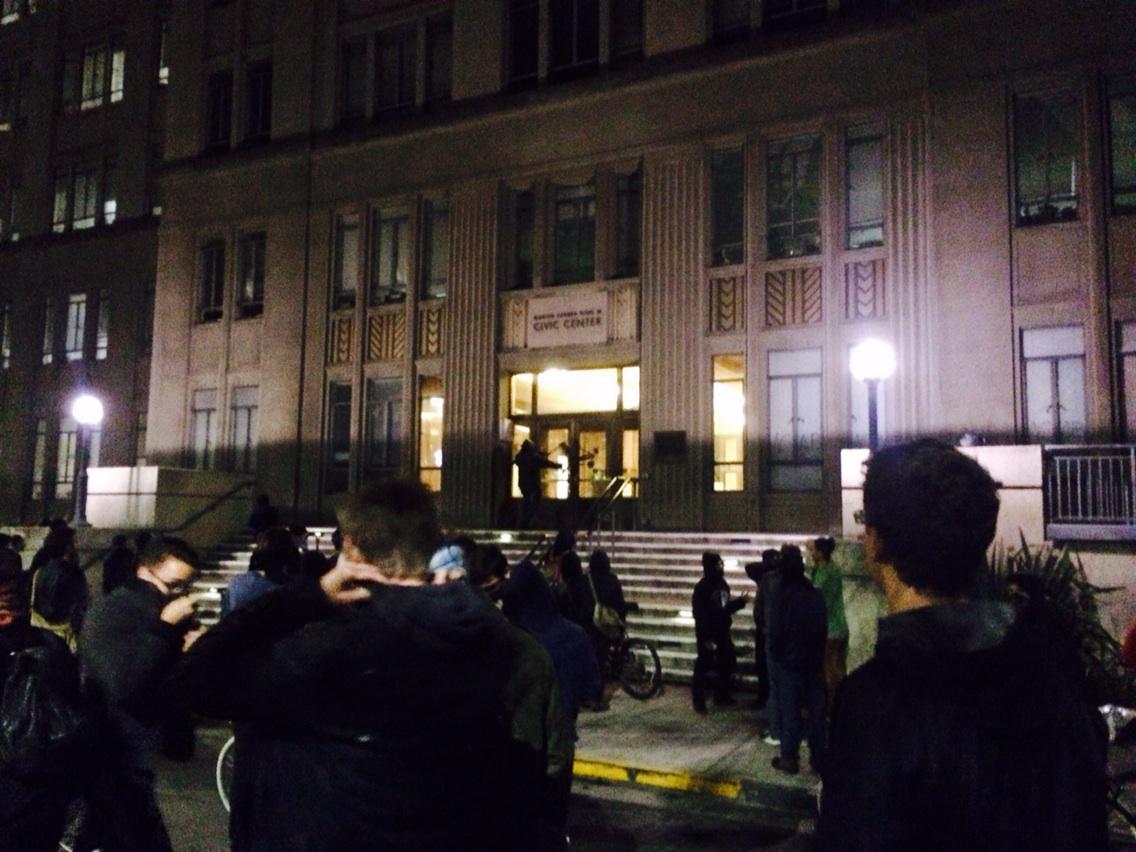
Late Sunday night, police said protesters returned to Berkeley streets, throwing trash cans, scattering garbage and sparking small blazes. Police said several businesses were damaged and looted, and they were checking reports of vandalism at City Hall.
View image on TwitterView image on Twitter
The demonstrations were the latest of several in the Bay Area — including in Oakland where activism is strong — in recent days to protest grand jury decisions in Missouri and New York not to indict while police officers in the deaths of two black men.
On Saturday night, three officers and a technician were hurt and six people were arrested when a similar protest turned unruly. The most serious injury was a dislocated shoulder, Berkeley police said.
Seven people were arrested in Seattle Saturday night after protesters threw rocks at police and attempted to block a highway. Politicians on both sides of the aisle have been calling for calm while activists push for police reforms. NAACP president Cornell William Brooks, appearing on CBS' "Face the Nation," called for outfitting police with body-worn cameras and changing law enforcement policy.
"They need to be listened to and they need to be responded to," Kasich said. "In our country today, there's too much division, too much polarization — black, white; rich, poor; Democrat, Republican. America does best when we're united."
View image on Twitter
The unrest in Berkeley follows violent disruptions of demonstrations in San Francisco and Oakland in recent days. Five San Francisco police officers sought medical treatment after sustaining injuries during a protest in downtown San Francisco on Black Friday.
On Saturday night, protesters broke away from a peaceful demonstration and began throwing rocks, bottles and pipes at officers.
Scores of law officers from several surrounding agencies joined the Berkeley Police Department in trying to quell unrest that went on for hours.
View image on Twitter
The San Francisco Chronicle reported that at one point, the marchers were face to face with a line of about 100 police in riot gear who turned the crowd back.
The newspaper said that it wasn't just protesters who were hit by tear gas.
Several concerts had let out from downtown sites and concertgoers waiting to pay in a nearby garage were enveloped in a cloud of stinging gas, sending them running into elevators.
KCBS reported that police closed two Bay Area Rapid Transit commuter train stations along the protest route.
Protesters had planned to march from the University of California, Berkeley, campus to Oakland's Civic Center.

Windows smashed as second night of Berkeley protests turn violent

B4uaumaciaa2nft

A second night of protests against police killings in Missouri and New York turned violent again in Berkeley as some demonstrators threw rocks and bottles at officers, assaulted each other and shut down a freeway, police said.
SEE ALSO: Fifth day of protests against police brutality spread across the U.S.
Sunday's protest began peacefully on the University of California, Berkeley campus. But as protesters marched through downtown Berkeley toward the neighboring city of Oakland, the unrest resumed as someone smashed the window of a Radio Shack. When a protester tried to stop the growing vandalism, he was hit with a hammer, Officer Jennifer Coats said.
View image on TwitterView image on TwitterView image on Twitter

Some of the protesters made their way to a freeway in Oakland and blocked traffic. The California Highway Patrol said some tried to light a patrol vehicle on fire and threw rocks and bottles. Police also said explosives were thrown at officers, but there was no information immediately available on how potent they were. Highway patrol officers responded with tear gas.
View image on Twitter

The highway patrol said it was making arrests but no figures were available.
Late Sunday night, police said protesters returned to Berkeley streets, throwing trash cans, scattering garbage and sparking small blazes. Police said several businesses were damaged and looted, and they were checking reports of vandalism at City Hall.
View image on TwitterView image on Twitter
The demonstrations were the latest of several in the Bay Area — including in Oakland where activism is strong — in recent days to protest grand jury decisions in Missouri and New York not to indict while police officers in the deaths of two black men.
On Saturday night, three officers and a technician were hurt and six people were arrested when a similar protest turned unruly. The most serious injury was a dislocated shoulder, Berkeley police said.
Seven people were arrested in Seattle Saturday night after protesters threw rocks at police and attempted to block a highway. Politicians on both sides of the aisle have been calling for calm while activists push for police reforms. NAACP president Cornell William Brooks, appearing on CBS' "Face the Nation," called for outfitting police with body-worn cameras and changing law enforcement policy.
"They need to be listened to and they need to be responded to," Kasich said. "In our country today, there's too much division, too much polarization — black, white; rich, poor; Democrat, Republican. America does best when we're united."
View image on Twitter
The unrest in Berkeley follows violent disruptions of demonstrations in San Francisco and Oakland in recent days. Five San Francisco police officers sought medical treatment after sustaining injuries during a protest in downtown San Francisco on Black Friday.
On Saturday night, protesters broke away from a peaceful demonstration and began throwing rocks, bottles and pipes at officers.
Scores of law officers from several surrounding agencies joined the Berkeley Police Department in trying to quell unrest that went on for hours.
View image on Twitter
The San Francisco Chronicle reported that at one point, the marchers were face to face with a line of about 100 police in riot gear who turned the crowd back.
The newspaper said that it wasn't just protesters who were hit by tear gas.
Several concerts had let out from downtown sites and concertgoers waiting to pay in a nearby garage were enveloped in a cloud of stinging gas, sending them running into elevators.
KCBS reported that police closed two Bay Area Rapid Transit commuter train stations along the protest route.
Protesters had planned to march from the University of California, Berkeley, campus to Oakland's Civic Center.


In a blow to Democrats, Louisiana Sen. Mary Landrieu defeated

Senate-louisiana-election

BATON ROUGE, La. — Republican Rep. Bill Cassidy defeated Democratic Sen. Mary Landrieu on Saturday, denying her a fourth term and extending the GOP's domination of the 2014 midterm elections that put Republicans in charge of Capitol Hill for the final two years of President Barack Obama's tenure.
With Cassidy's victory, Republicans will hold 54 seats when the Senate convenes in January, nine more than they have now. Republican victories in two Louisiana House districts Saturday — including the seat Cassidy now holds — ensure at least 246 seats, compared to 188 for Democrats, the largest GOP advantage since the Truman administration after World War II. An Arizona recount leaves one race still outstanding.
SEE ALSO: Senate rejects Keystone XL pipeline
With nearly all the votes counted, unofficial returns showed Cassidy with a commanding victory.
View image on Twitter
Landrieu had narrowly led a Nov. 4 primary ballot that included eight candidates from all parties. But at 42 percent, she fell well below her marks in previous races and endured a one-month runoff campaign that Republicans dominated via the air waves while national Democrats financially abandoned her effort.
Landrieu's defeat is a blow for one of Louisiana's most famous political families, leaving her brother, New Orleans Mayor Mitch Landrieu, to carry the banner.
The GOP sweep also denied former Gov. Edwin Edwards a political comeback; the colorful 87-year-old politician, who had served four terms as governor in the past, sought a return to public office after eight years in federal prison on corruption charges.
In the South, Democrats will be left without a single governor or U.S. senator across nine states stretching from the Carolinas to Texas. The House delegations from the same region are divided almost entirely by race, with white Republicans representing majority-white districts, while majority non-white districts are represented by black or Hispanic Democrats.
Cassidy, who spent most of his campaign linking Landrieu to Obama, called his win "the exclamation point" on the message that voters sent nationally on Nov. 4.
"This victory happened because people in Louisiana voted for a government that serves us, that does not tell us what to do," Cassidy said in a brief victory speech in Baton Rouge.
He did not mention Obama or offer any specifics about his agenda in the Senate, but said he believes voters have demanded "a conservative direction" on health care, budgets and energy policy. Cassidy did not take questions after his speech.
Speaking a half hour before in New Orleans, Landrieu struck an upbeat chord. "We may not have won tonight, but we have certainly won some extraordinary victories," she told supporters, citing her role in directing additional oil and gas royalties to Louisiana and securing federal aid after multiple hurricanes and the 2010 Gulf Oil Spill.
"It's been a fight worth waging," she said. "Louisiana will always be worth fighting for."
She also said she was "proud" of her efforts to expand health care access, though she didn't specifically mention the Affordable Care Act.
The Louisiana race mirrored contests in other states Obama lost in 2012, with Landrieu, 59, joining Alaska Sen. Mark Begich, North Carolina Sen. Kay Hagan and Arkansas Sen. Mark Pryor in defeat. Democrats ceded seats in Montana, South Dakota and West Virginia after incumbents opted not to run again.
But in a state where 73 percent of white voters on Nov. 4 told pollsters they "strongly disapproved" of the president, that was enough to prevent Landrieu from finding her footing. Cassidy also enjoyed a prodigious advertising advantage in the runoff: Of every dollar spent by outside groups during the one-month runoff, 97 cents benefited the congressman.

Like victorious Republicans in those races, Cassidy, 57, made his bid against Landrieu more about Obama than about his own vision for the job. An Illinois native, Cassidy made few public appearances during the runoff, seeking to avoid missteps that could change the race.

Landrieu tried several messages over the course of her losing effort.
Most recently, she had hammered Cassidy as unfit for the job and more interested in partisanship than helping Louisiana. She directed her most pointed criticism at Cassidy's medical teaching job in Louisiana State University's hospital system.
Calling Cassidy "Dr. Double Dip," Landrieu suggested he collected a $20,000, taxpayer-funded salary for little or no work, describing gaps and discrepancies in Cassidy's LSU timesheets. LSU said it's looking into the timesheet questions.
She argued that the race shouldn't be about Obama, but also targeted advertising on radio stations geared to the black community, where the president remains popular.
Her anchor argument was that her seniority was a boon for Louisiana, particularly her chairmanship of the Senate's energy committee, an important panel for this oil-rich state. But that argument was gutted on Nov. 4 when Republicans won the Senate majority, meaning Landrieu would have lost her post even had she won.

U.S. sends 6 Guantanamo Bay prisoners to Uruguay to be resettled as refugees

Guantanamo-bay-uruguay

MIAMI — Six prisoners held for 12 years at Guantanamo Bay have been sent to Uruguay to be resettled as refugees, the U.S. government announced Sunday — a deal that had been delayed for months by security concerns at the Pentagon and political considerations in the South American country.
The six men — four Syrians, a Tunisian and a Palestinian — are the first prisoners transferred to South America from the U.S. base in Cuba, part of a flurry of recent releases amid a renewed push by U.S. President Barack Obama to close the prison.
SEE ALSO: U.S. sends 5 Guantanamo prisoners to Georgia, Slovakia
All were detained as suspected militants with ties to al-Qaeda in 2002, but were never charged. They had been cleared for release since 2009, but could not be sent home, and the U.S. struggled to find countries willing to take them.
Uruguayan President Jose Mujica agreed to accept the men as a humanitarian gesture, and said they would be given help getting established in a country with a tiny Muslim population of perhaps 300 people.
"We are very grateful to Uruguay for this important humanitarian action, and to President Mujica for his strong leadership in providing a home for individuals who cannot return to their own countries," U.S. State Department envoy Clifford Sloan said.
Among those transferred was Abu Wa'el Dhiab, a 43-year-old Syrian on a long-term hunger strike protesting his confinement, who was at the center of a legal battle in U.S. courts over the military's use of force-feeding.
The Pentagon identified the other Syrians sent to Uruguay on Saturday as Ali Husain Shaaban, 32; Ahmed Adnan Ajuri, 37; and Abdelahdi Faraj, 39. Also released were Palestinian prisoner Mohammed Abdullah Taha Mattan, 35, and 49-year-old Adel bin Muhammad El Ouerghi of Tunisia.
Uruguayan officials declined comment Sunday on the transfers. Adriana Ramos, a receptionist at a military hospital in Montevideo, the capital, said the six men were being examined there, but declined to provide any details.
Cori Crider, a lawyer for Dhiab from the human rights group Reprieve, praised Mujica, a former political prisoner himself, for accepting the men.
"Despite years of suffering, Mr. Dhiab is focused on building a positive future for himself in Uruguay," said Crider, who traveled to Montevideo to meet with him, and was concerned about his health after his prolonged hunger strike. "He looks forward to being reunited with his family and beginning his life again."
Ramzi Kassem, a lawyer for Faraj, said he was "deeply grateful" to Uruguay for accepting the prisoner.
"By welcoming our client and the others as refugees and free men, not as prisoners, Uruguay has shown that it truly possesses the courage of its convictions," Kassem, a law professor at the City University of New York, said in an interview from Panama.
"We hope that other countries in Latin America and throughout the world will soon follow Uruguay's example, and help put an end to the U.S. government's shameful practice of indefinite imprisonment without charge or fair process," he added.
The U.S. has now transferred 19 prisoners out of Guantanamo this year — all but one of them within the last 30 days. Saturday's move brings the total number of prisoners still at Guantanamo to 136 — the lowest number since shortly after the prison opened in January 2002. Officials say several more releases are expected by the end of the year.
Obama administration officials had been frustrated that the transfer took so long, blaming outgoing Defense Secretary Chuck Hagel for not approving the move sooner. They said after Mujica had agreed to take the men in January, the deal sat for months on Hagel's desk, awaiting his signature as required by law. The Pentagon didn't send notification of the transfer to U.S. Congress until July.
By then, the transfer had become an issue in Uruguay's political election, and officials there decided to postpone it until after the vote. Tabare Vazquez, a member of Mujica's ruling coalition and a former president, won a runoff election on Nov. 30.
Upon taking office, Obama had pledged to close the prison, but was blocked by Congress, which banned sending prisoners to the U.S. for any reason, including trial, and placed restrictions on sending them abroad.
The slow pace of releases has created a tense atmosphere inside the prison. A hunger strike that began in February 2013 totaled about 100 prisoners at its peak, including Dhiab and Faraj.
The U.S. now holds 67 men at Guantanamo who have been cleared for release or transfer, but like the six sent to Uruguay, can't go home because they might face persecution, a lack of security or other reasons.
Prisoners from Guantanamo have been sent around the world, but this weekend's transfer was the largest group sent to the Western Hemisphere. Four Guantanamo prisoners were sent to Bermuda in 2009, and two were sent to El Salvador in 2012, but have since left.

Typhoon Hagupit begins agonizingly slow trek across Philippines, deadly floods likely

Hagupitdaynight

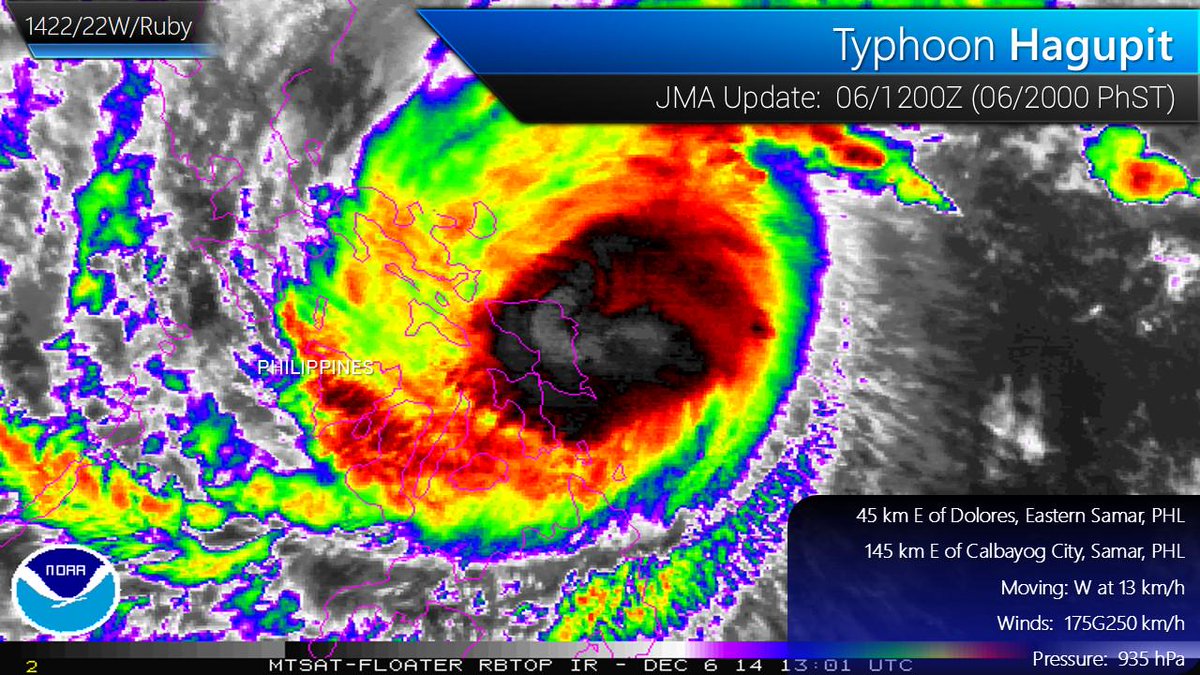
Typhoon Hagupit, which was once the strongest typhoon of the year, is making landfall as of 10:15 a.m. ET (9:15 a.m. local time) near the northern edge of the Philippine island of Samar, close to the community of Dolores. The storm is the equivalent of a Category 3 hurricane, with maximum sustained winds of about 125 miles per hour.
Samar was also the landfall location of Super Typhoon Haiyan in 2013, which killed at least 6,000 people, and displaced more than 100,000. However, that storm hit the island's southern edge.
While Typhoon Hagupit, which is also known as Typhoon Ruby in the Philippines, is nowhere near the intensity of Haiyan, its slow forward speed of about 13 miles per hour poses a different threat: flooding. Tropical storms and typhoons can dump incredible amounts of rainfall and rain totals with Hagupit may exceed 2 feet in some places, particularly where winds blow up the slope of mountains, since this can enhance rainfall in a process known as orographic lifting.
View image on Twitter


Evacuations have been underway since Thursday for parts of Samar, including the city of Tacloban, which Haiyan severely damaged. International aid organizations, from Heifer International to the Red Cross, already have large teams on the ground in Samar that have been assisting with evacuations. They have also been preparing to undertake relief operations once dangerous storm conditions abate. However, It does not appear that Tacloban is taking the brunt of the storm.
Coastal areas of northern Samar are being warned to prepare for a storm surge of 15 feet.
View image on Twitter

From Samar, the typhoon is predicted to slowly hopscotch across at least five more islands in the Philippines, bringing the risk of flooding, storm surge and high winds all the way to the capital city of Manila.

Precipitation Hagupit

While the worst of the storm's winds are buffeting Samar, and the storm is in a weakening phase, it will likely remain a formidable typhoon all the way to Manila.

New JMA Track

Next to feel the full force of the storm is the island of Masbate, including Masbate City, followed by Romblon, Mandoro and southern portions of Leyte, including low-lying and flood-prone Manila.

Even in the United States, floods are an underemphasized hazard of tropical cyclones, since the high wind and storm surge often get the most attention. However, floods can and do kill many more people, even from weaker storms. This is a particularly high threat in developing countries such as the Philippines, where a rapidly growing population has increased the public's exposure to landslides and other typhoon-related hazards.


Sobering daylight in Ferguson exposes a city in shambles

Ferguson3

Daylight shed a sobering light on Ferguson, Missouri, and the surrounding communities on Tuesday after a night of violent protests rocked the city.
Tensions quickly rose following the announcement that Ferguson police officer Darren Wilson would not be indicted for the shooting death of unarmed teenager Michael Brown on Aug. 9. Protesters swiftly took to the streets demanding justice for Brown.
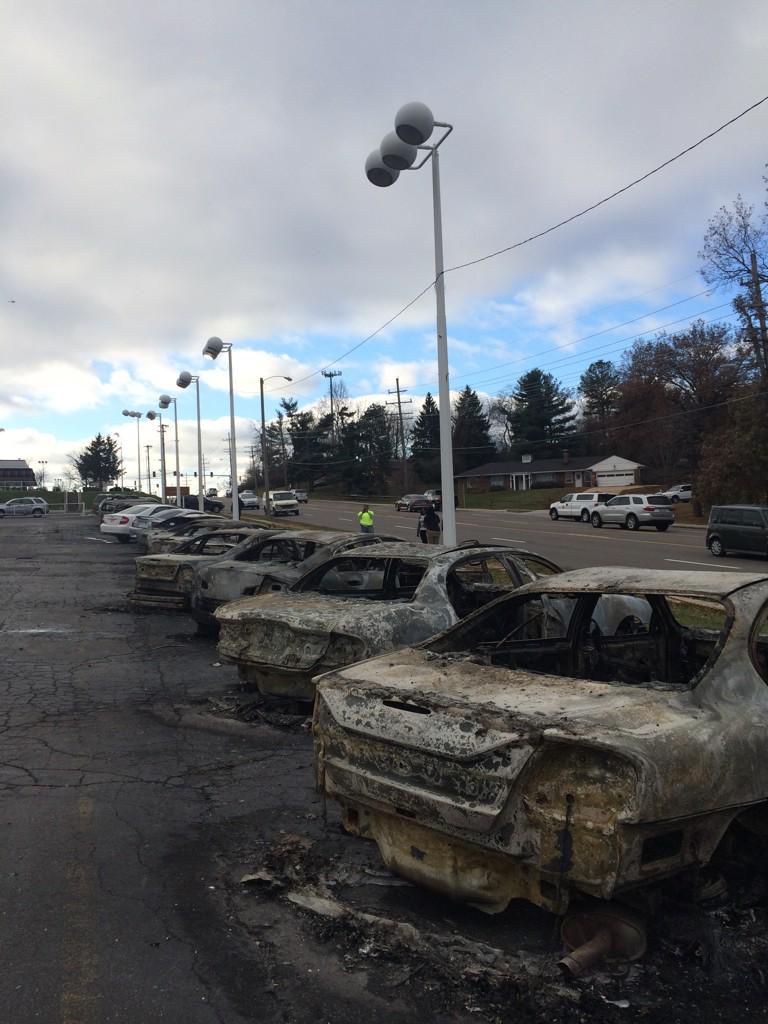
By the end of the night, businesses had been burned, cars torched, stores looted and shots fired. The protests escalated far beyond any of the uprising in Ferguson in August.
Overnight, 61 people were arrested in Ferguson, according to St. Louis County Police spokesman Brian Schellman. Less than 10 miles away, in St. Louis, there were 21 arrests, according to St. Louis Mayor Francis Slay.
Speaking during a press conference on South Grand Avenue on Tuesday morning, Slay appealed for peace in the community amid piles of broken glass; 21 windows were broken in the area overnight, Slay added.
"I first and foremost condemn the terrible violence that occurred in Ferguson," said Slay. "
 A storage site was still smoldering on Tuesday morning after being set alight on Monday night.It's unacceptable, it's wrong. The vast majority of people living in our region condemn it as well."
View image on Twitter
One reporter surveying the scene likened the streets of Ferguson to a city after a natural disaster.
View image on Twitter
Burned out cars lined the streets near Ferguson City Walk.

It's unacceptable, it's wrong. The vast majority of people living in our region condemn it as well."A storage site was still smoldering on Tuesday morning after being set alight on Monday night.


View image on Twitter
Local businesses remained boarded up while some community members took to the streets to begin cleanup efforts.
View image on Twitter


Mayor Slay emphasized that violent protesters made up just a small portion of the larger group of demonstrators.

"This is a very good community of a lot of people who care deeply about our city who are investing in their community. they are working hard to bring back this area of the city," Slay said.

 "They don't deserve it. The people of our community do not deserve this kind of violence."


View image on Twitter


United Arab Emirates Plans to Create Space Program, Land Mars Probe

Mars2

The United Arab Emirates has jumped into the international space race at a full sprint,announcing plans on Wednesday to create a space program and send an unmanned probe to Mars by 2021.
"The UAE Mars probe represents the Islamic world’s entry into the era of space exploration," UAE President Sheikh Khalifa bin Zayed Al Nahyan said, according to Reuters. "We will prove that we are capable of delivering new scientific contributions to humanity."
SEE ALSO: 15 Twitter Accounts Every Space Lover Should Follow
The proposed space program is the latest costly project for the country, which has one of the top 10 GDP per capita income in the world. It previously constructed the world's tallest skyscraper and recently announced plans to create a climate-controlled city.
In the statement announcing the space program, officials said they are seeking to foster growth in the country's technology sectors and diversify its economy. According to the National, the UAE has already invested 20 billion dirhams (approximately $5.9 billion) in space technology, and plans to launch the Mars probe in 2021 in tandem with its 50th anniversary.
If successful, the UAE would join the U.S. and Russia as one of the only countries to successfully send an unmanned probe to Mars. However, Haym Benaroya, a professor of mechanical and aerospace engineering at Rutgers University, said he is skeptical about the project's plausibility.
"I certainly support them doing it, it's a great thing to do, but I think they'll have a hard time doing that by 2021," he told Mashable. "I'm sure eventually they could do it if they wanted to, but Mars has a long history of being difficult to land on, even for the U.S. and Russia, who have a lot more experience."
Benaroya added that in a half century of sending missions to Mars, only 50% have made it to their destination. "My view is that its a positive thing they want to do, but I think it might be more difficult than they anticipate, so the timeline they gave themselves might be really challenging," he said. "If I were advising the UAE I would advise them to go to the moon first."
The mission would last from 9 months to a year depending on when the probe, which would travel 37.5 million-miles, is launched.
Despite doubts about the UAE's ability to complete the project, the country remains confident in its mission.
“We chose the epic challenge of reaching Mars because epic challenges inspire us and motivate us," President Sheikh Khalifa bin Zayed Al Nahyan said. "The moment we stop taking on such challenges is the moment we stop moving forward.”

Drone Beat: Flying in Gaza, at a Congressman's Wedding and More

Israeli-drone

The U.S. government uses them to bomb alleged terrorists in far-away places. Tech companies like Amazon, Google and Facebook are all toying with the idea of using them, and now they're a photographer's secret weapon. Drones are a big part of our lives, whether we see them or not. Drone Beat collects the best and most important stories every week.


Judge delivers another blow to the FAA

For the second time in just over four months, a judge has ruled against the Federal Aviation Administration (FAA) in a case involving drones.
On Friday, an appeals court judge said that EquuSearch, a Texas-based company that uses UAVs for search and rescue operations can legally fly its drones, and that the cease and desist email that the FAA sent the group earlier this year didn't have any legal effects, as reported byMotherboard.
The ruling was a win for EquuSearch, which will resume its drone flights right away. However, the ruling doesn't address the larger issues regarding drone regulation, which at this point aremurky, but it's a huge loss for the FAA, which has to face yet another court ruling saying that the agency is on shaky ground when it comes to preventing pilots from flying drones.
"The court's decision in favor of the FAA regarding the Texas EquuSearch matter has no bearing on the FAA's authority to regulate" drones, the agency said in a statement. "The FAA remains legally responsible for the safety of the national airspace system. This authority is designed to protect users of the airspace as well as people and property on the ground."

Drone wars between Israel and Hamas

Earlier this week, Israel claimed to have shot down a drone controlled by Hamas. The militants later claimed to have developed three types of drones, including two capable of carrying out attacks.
The group even posted a video on YouTube purportedly showing one of the drones, seemingly armed with missiles — although experts consulted by Mashable were skeptical of the drone's real capabilities.


Congressman hires drone to shoot wedding, gets investigated

Rep. Sean Patrick Maloney (D-N.Y.) paid an aerial photography company to shoot his wedding with a drone last month, as revealed this week.
As we've noted repeatedly, the FAA says that the commercial use of drones — including hiring photography companies to take pictures using them — is prohibited. Perhaps Maloney was unaware of the regulations? Probably not, since he actually sits on a congressional subcommittee that oversees the FAA itself.
In any case, his use of flying bots to film his wedding is now under FAA investigation.
As Quartz noted, Maloney is hardly the only one who is doing this. Several photography companies are offering their services for weddings

Students Sue Google for Monitoring Their Emails

Google.jpg

In a challenge to one of Google's more controversial practices, a group of students in California are suing Google, claiming that the company's monitoring of Gmail violates federal and state privacy laws.
The U.S. District Court for the Northern District of California is currently hearing the complaint from nine students whose emails were subject to Google surveillance because Gmail is a component of Apps for Education. Apps for Education is a suite of free, web-based education tools that has some 30 million users worldwide, most of whom are students under 18 exposed to the software via their schools.
A Google rep told Education Week that the company scans and indexes emails from all Apps for Education users. The company uses the data for potential advertising, among other purposes.
Education Week speculates that the case could have "major implications" for how the Family Educational Rights and Privacy Act [FERPA] is interpreted. FERPA, which was issued in 1974, ensures the privacy of records of students under the age of 18. The Department of Education'srecent guidance on the issue also appears to indirectly state that Google's Gmail practices run afoul of FERPA.
The students are seeking class-action certification for the case.  
If successful, that could lead to a payment to millions of Gmail users. However, in a victory for Google, U.S. District Judge Lucy Koh in San Jose, Calif., on Tuesday declined to combine other related suits against Google's Gmail on similar grounds into one class-action suit.Google's surveillance of Gmail for advertising purposes has raised hackles among privacy advocates. In particular, the ElectronicPrivacy Information Center (EPIC) points out that even if Gmail users agree to Google's terms, that doesn't mean that non-subscribers who email with them do. "Non-subscribers have not consented and indeed may not even be aware that their communications are being analyzed or that a profile may be compiled of him or her," states anFAQ on EPIC on the subject. EPIC also takes issue with Google's ability to compile a detailed profile of a Gmail user by linking their Gmail data with cookies used by Google's search engine. Google has said that it doesn't cross-reference such data.

Microsoft has also criticized Google's Gmail practices in its Scroogled campaign, contrasting Google's data mining with Microsoft's Outlook, which doesn't use email data to serve users ads.

But Really, Where's the Missing Plane? Search Appears to Hit Brick Wall

Relativesmh370As we near the two-week mark since Malaysia Airlines Flight 370 vanished after its takeoff from Kuala Lumpur International Airport, the investigation into the plane's disappearance has appeared to hit a brick wall.
A week of breaking developments that revealed a stunning number of facts — the transponders were deliberately turned off, the plane traveled for more than seven hours after its last contact with ground control — has given way to days of baseless speculation.
Among the leading theories: The plane was hijacked and either crashed into the sea or landed at some unknown runway, or it crashed into the southern Indian Ocean, hundreds of miles off the western shore of Australia.
Hishammuddin Hussein, the acting Malaysian Minister of Transport, spoke at an afternoon press briefing on Wednesday and said the focus of the international effort remains a search and rescue operation.
He addressed reports that the plane was spotted in the Maldives ("not true") and confirmed that all of the plane's passengers, crew and ground staff handling the aircraft were now under investigation.
Officials at the press briefing also said that investigators were taking a closer look at Captain Zaharie Ahmad Shah's flight simulator, which was seized from his house earlier this week.

“The experts are looking at what are the logs, what has been cleared,” said Tan Sri Khalid Bin Abu Bakar, the inspector-general of the Malaysian police. They have enlisted the FBI's help in recovering the data.
"Local and international expertise has been recruited to examine the pilot’s flight simulator," the acting transportation minister said, adding that some of the data had been deleted from the simulator and forensic work to retrieve this data is on-going.
Meanwhile, experts are raising doubts over the "northern corridor" theory, which suggests the plane may have traveled along a route taking it across the Bay of Bengal, over India, through its border with Pakistan, and across Afghanistan — countries with "the most closely defended borders in the world," according to the New York Times.
It is difficult to get a complete picture of the radar capabilities of countries in the region because military officials are unwilling to disclose details of their air defense systems. But experts said that the military forces arrayed in the Asian interior, especially in China, India, Pakistan and Afghanistan, would not be likely to overlook or ignore unidentified aircraft.
This leaves the wide swath of the Indian Ocean as the likely landing place for the missing plane — not a good sign for those hoping its passengers will be found alive. It also means the race is on to find the "black box," which has just 30 days of battery power.
"We will persevere," Hussein said, concluding his remarks. "Our immediate focus is the search and rescue operation. We are pursuing every means possible to narrow the two search corridors."
Relatives of the missing passengers appear to be growing impatient with the slow progress in the hunt for the missing plane. They announced Tuesday that some would be going on a hunger strike to protest a lack of information, and on Wednesday, a group stormed the press briefing room and unfurled a banner demanding that the government “tell the truth.” Wailing and screaming, they were forcefully removed from the room.

From Bethlehem to D.C.: Christmas Around the World

United-states-2

On Christmas Eve, two American astronauts spent the day in space, working to fix the cooling system on the International Space Station.
Down here on Earth, though, the celebrations are mostly confined to land and sea. From soldiers sharing a special meal in Afghanistan to Santa waterskiing in Maryland, people and cultures around the world observe Christmas Day with their own sets of traditions. Some of these traditions are centuries old, like gathering in the little town of Bethlehem; others were brought on by circumstance this year, like families in Tacloban, Philippines, finding Christmas joy amid the post-Typhoon Haiyan destruction.
Our collection of Christmases, below, traverses the globe in 28 photos.